Posts

Carnatic Instrumental Music: Need for a change?

Image
(Ganesh Kumaresh) Given my work commitments it is becoming difficult to keep posting regularly. Yet sometimes something happens which makes you drop what you are doing and jot down your thoughts. A good friend sent me a youtube link of Kumaresh (of Ganesh - Kumaresh duo) giving a TED lecture cum demonstration at NIT Suratkal (as per the video.) This set me thinking. I wanted to jot down my thoughts. First, here is the  youtube video: It is a nice video. Do listen to what he says and also listen to his playing of Begada ragam. I am sure you have heard what he said but just in case you skipped (or are behind a firewall which doesn't allow youtube), here is the crux of what he spoke. Instrumental music is very different from vocal music. In Carnatic music all instrumentalists play the krithis. While the words of the krithis are good for vocal music, they are not necessary for instrumental music. So they (Ganesh and Kumaresh) play pieces where they explore a raga wit...

One Song at a time - 54. Hirabai's Hindustani Aarabhi

Image
(Hirabai Barodekar) "What is the Hindustani equivalent of Carnatic Aarabhi?", asked a friend on twitter. With confidence ignorance instills, "There is no Aarabhi in Hindustani", I replied. Doubts started seeping in after I replied and I started my search and hit this song on youtube. It is Hirabai Barodekar singing what appears to a Marati Natyageet and the title says it is Aarabh. The song sounds close to Aarabhi. At the same time I also hear a lot of Suddha Saveri in it. So it may not be an exact equivalent to Carnatic Aarabhi. Yet I don't hear it as straigh Durga, which is the Suddha Saveri equivalent. In Carnatic music, Aarabhi, Suddha Saveri, Devagandhari and Saama are close to each other based on the notes they use. I believe Aarabahi and Devagandhari have the same set of notes. They differ in the way the notes are sung. S.Ramanathan, in one lec dem, demonstrates how Aarabi and Sama share the same notes and yet differ in the nyasa swara used....

African Brindavana Saranga

Image
(Vieux Parka Toure) How different cultures and countries across the world use various ragams has always fascinated me. I had earlier posted about how Mohanam in available almost throughout the world and also about Azebaijani Todi . Yesterday late at night, my twitter friend Vipin Nair (@MusicAloud) sent me a clip of African music asking me if the ragam played was Madhyamavathi, Sree Ragam or Brindavana Saranga. (Vipin had got that clip from his friend @aiyerravi ) When I heard the clip, I was amazed by the playing of the guitarist (Vieux Parka Toure). The playing was crisp and every note sounded so clear. And very importantly, I heard a lovely Brindavana Saranga. This was a revelation to me. I have heard Madhyamavathi in various settings but Brindavana Saranga, to me, has been confined to Carnatic and Hindustani music.   Following some threads from the youtube clip, I came upon some Algerian music. In this I could hear Madhyamavathi. Ragas like Suddha Saveri, Suddha Dhan...

One Song at a time - 53.Thamasammenthe Varuvan

Image
(M.S.Baburaj) A lot of South Indian Film Music directors were influence by Hindustani Music as well as by Hindi Film Music directors. You can find the Hindustani strains in lot of films songs of Telugu, Tamil and Malayalam. 'Karnan' (Tamil) is an excellent example of North Indian influence. The hugely popular 'Sivashankari' ('Jagadekaveeruni Katha') is another example. One of the music directors from Malayalam film industry who was very much influenced by Hindustani music and Hindi film music was M.S.Baburaj.  (I realized quite late that I have not written about this excellent music director. I had written about the other greats of Malayalam film music but somehow missed him. As they say, better late than never.) I first came to know about M.S.Baburaj through a piece on Janaki written by Saravanan in dhool.com. In that article Saravanan compared Baburaj-Janaki combination to Madanmohan-Lata combination. When such a comparison is done, it is bu...

One Song at a time - 52. Suno Sajna Papihe Ne

Image
 (Lakshmikanth Pyarelal) The last song on the 'Chitrahaar' program was 'suno sajna'. We had all gathered in the TV room of or gymkhana to watch the program. Once it ended, the discussion started. Those were the times when we were learning to identify the signature of the music directors. Who could be the music director of this song? Was it Madanmohan or Roshan or Salil? Lot of names were proposed by Siva and me and were disposed off. Probably unable to overcome his hunger pangs, a vexed Krishnamohan said, "For all the debate, it may end up being a Lakshmikanth Pyarelal song." All of us laughed out loud. The discussion ended with us proceeding to the canteen for dinner. It was Lakshmikanth Pyarelal who had the last laugh. That song from the movie, 'Aaye Din Bahar Ke', was indeed tuned by them. The incident clearly indicates the image that Lakshmikanth Pyarelal had in our midst. We had grown up with lot of their songs and unfortunately could ...

One song at a time - 51. Jab Deep Jale Aana

Image
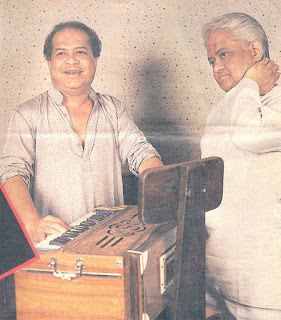
(Jesudas & Ravindra Jain) Do you recall any movie in which every song invokes a "All izz well" feeling in you? There are many movies in which every song is a gem but they may not necessarily evoke the 'feel good' factor. I can only think of a few movies which have such songs. One of them is 'Chitchor'.  'Chitchor' was a Rajshri Productions film, the production house started by Tarachand Barjatiya. Their philosophy in the 70s was simple. As in 'keep it simple, silly'. (The acronym would never happen in their movies.) Have a simple, idealistic story, which will appeal to the 'family audience'. Cast newcomers. Keep the budget low. Provide lovely music. In short, they depended on their stories and songs. Not on stars and marketing drives. They were successful for a long time. They left behind some superb melodies which the children of 70s can never forget, for all of them were 'feel good' melodies. They made mo...

One song at a time - 50.Manasilunaroo

Image
Our festivals and music are highly interlinked. One cannot miss the festival music, even if you want to. For, the nearby temple will be blaring out the songs from those tinny loudspeakers. Ganesh Chaturthi is one festival where you get to hear songs in most parts of India. In Hyderabad, along with Ganesh Chaturthi, we have the Mahakali jatra time. The Mahakali festival itself stretches over more than a month. During this time every small Mahakali temple will celebrate and you get to hear songs day in and day out. Especially during the weekend, as the festival will be celebrated on Sundays. Added to these loud speakers, you also have the 'potha raju' and the famous live 'teen maar' of Hyderabad. All I have to do is type, 'dha dhanakur dhan' and the rhythm will immediately start playing in any true Hyderabadi's mind. So embedded is this 'teen maar' in our mind. ( I have not analyzed it but I have a feeling that 'teen maar' probably is equ...