Posts

Showing posts with the label mohammed rafi

Lata Mangeshkar - The Queen : Part 22: Her Legacy

Image
Here is the link to read all parts of this series. In this last part, let us look at Lata's legacy. Lata came into Hindi film music when modernity was creeping into it, and music directors like Ghulam Haider, Anil Biswas, Sajjad Hussain, Shankar Jaikishen and others were pushing the boundaries of Hindi film music. It must be said that she became an integral part of this push towards modernity. The range of her voice and her singing skills enabled music directors to compose music without fear, for they know Lata would give perfect expression to their musical ideas. She was sought after by every music director in the initial days, though later, O.P. Nayyar did not work with her. She was an integral part of the golden generation of Hindi film music that spanned more than two decades, from the late 40s to the late 60s.  Lata has left behind an amazing body of work, that would be extremely difficult for any current-day singer to match. This is due to two reasons: one, music directors ar...

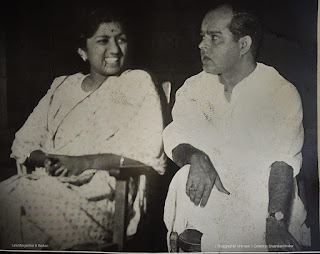
Lata Mangeshkar - The Queen: Part 20 - Lata and Rafi

Image
Here is the link to read all parts of this series. Lata Mangeshkar and Rafi were probably seen as a natural pairing due to their being the most in-demand female and male voices, respectively, and also because both were trained in classical music. Their approach to music was different, though. Rafi believed in emoting very explicitly with his voice, while Lata preferred her voice to be under her control all the time. Rafi's tone, too, was different from Lata's. His vocal modulations had a more in-your-face attitude compared to Lata's polished performance in this aspect. Of course, the way they sang depended quite a bit on who the composer was, but overall these can be seen as the major difference in their approach.  Lata and Rafi had some differences in the early 1960s and didn't sing together for a few years. During the rift, Rafi was mostly accompanied by Suman Kalyanpur instead of Lata, while Lata was accompanied by Mahendra Kapoor during that time. (I would say that ...

Lata Mangeshkar - The Queen : Part 15 : The dominance continues: Late 60s and Roshan

Image
The link to all parts of this series is given here: Series Links The later part of the 60s is an important transition era for Hindi film music. This is when new music directors started entering the field and making a name for themselves. The earlier music directors were slowly fading away. By the 1970s, this transition would be fully complete, but the seeds were sown in the late 60s. R D Burman, Laxmikanth Pyarelal, and Kalyanji Anandji - the three music directors who would dominate a large part of the 70s - had their initial success during this time. The music, too, started changing, and Lata had to adapt herself to the new music the newcomers were putting up. Of course, the earlier masters still made good music, but the trend change was in the air. Let me initially talk about Lata and Roshan before moving to the other songs of the second half of the 1960s. Like Madanmohan, whose music we heard earlier, Roshan was a genius when at producing great melodies. Lata had great respect for h...

Lata Mangeshkar - The Queen : Part 4 - Naushad and Lata Mangeshkar

Image
The link to all parts of this series is given here: Series Links In the last part, we saw the partnership between music director Anil Biswas and Lata Mangeshkar. Anil Biswas was a hugely influential music director and I had mentioned how he had mentored Lata in her early days. The other major music director of those times was Naushad. He was one of the 'hit' music directors of those and was much sought after by everyone. By the time Lata entered the industry, he was already a leading music director who had given major hits with Noorjahan, Zorabai, and others. In this part, we will look at the songs of the Naushad Lata combination. Naushad's orchestration was different from that of Anil Biswas. In Anilda's orchestration, the rhythm is subtle in most songs; it doesn't dominate the song. The singing also requires more modulation. In Naushad's early Lata songs, the domination of rhythm can be clearly heard. The singing is more open-throated. In fact, in the early so...