Posts

Showing posts with the label roshan

Lata Mangeshkar - The Queen : Part 22: Her Legacy

Image
Here is the link to read all parts of this series. In this last part, let us look at Lata's legacy. Lata came into Hindi film music when modernity was creeping into it, and music directors like Ghulam Haider, Anil Biswas, Sajjad Hussain, Shankar Jaikishen and others were pushing the boundaries of Hindi film music. It must be said that she became an integral part of this push towards modernity. The range of her voice and her singing skills enabled music directors to compose music without fear, for they know Lata would give perfect expression to their musical ideas. She was sought after by every music director in the initial days, though later, O.P. Nayyar did not work with her. She was an integral part of the golden generation of Hindi film music that spanned more than two decades, from the late 40s to the late 60s.  Lata has left behind an amazing body of work, that would be extremely difficult for any current-day singer to match. This is due to two reasons: one, music directors ar...

Lata Mangeshkar - The Queen: Part 20 - Lata and Rafi

Image
Here is the link to read all parts of this series. Lata Mangeshkar and Rafi were probably seen as a natural pairing due to their being the most in-demand female and male voices, respectively, and also because both were trained in classical music. Their approach to music was different, though. Rafi believed in emoting very explicitly with his voice, while Lata preferred her voice to be under her control all the time. Rafi's tone, too, was different from Lata's. His vocal modulations had a more in-your-face attitude compared to Lata's polished performance in this aspect. Of course, the way they sang depended quite a bit on who the composer was, but overall these can be seen as the major difference in their approach.  Lata and Rafi had some differences in the early 1960s and didn't sing together for a few years. During the rift, Rafi was mostly accompanied by Suman Kalyanpur instead of Lata, while Lata was accompanied by Mahendra Kapoor during that time. (I would say that ...

Lata Mangeshkar - The Queen : Part 19 - Lata and Mukesh

Image
Here is the link to read all parts of this series. In this part and the next couple of parts of this series, we will talk about Lata's partnership with famous male singers: Mukesh, Rafi and Kishore. We start with the partnership of Lata and Mukesh. It is very difficult to find two contrasting voices than Lata and Mukesh. Mukesh is a mystery for many people. People accuse him of slipping from the 'sur' sometimes; he is accused of being nasal, and it is well known that his vocal range was limited. He also had the reputation of being suitable only for singing sad songs. Lata's voice was in contrast to that of Mukesh. Her range was incredible, her voice dripped honey, and she could sing any song that the music director threw at her. There is another important contrast between the two. For many music directors, Lata was the first choice. Whereas a lot of music directors were not keen on working with Mukesh, maybe they felt his range was too limited for them. So you don't...

Lata Mangeshkar - The Queen : Part 15 : The dominance continues: Late 60s and Roshan

Image
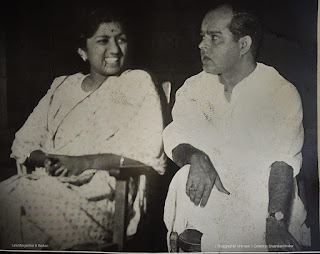
The link to all parts of this series is given here: Series Links The later part of the 60s is an important transition era for Hindi film music. This is when new music directors started entering the field and making a name for themselves. The earlier music directors were slowly fading away. By the 1970s, this transition would be fully complete, but the seeds were sown in the late 60s. R D Burman, Laxmikanth Pyarelal, and Kalyanji Anandji - the three music directors who would dominate a large part of the 70s - had their initial success during this time. The music, too, started changing, and Lata had to adapt herself to the new music the newcomers were putting up. Of course, the earlier masters still made good music, but the trend change was in the air. Let me initially talk about Lata and Roshan before moving to the other songs of the second half of the 1960s. Like Madanmohan, whose music we heard earlier, Roshan was a genius when at producing great melodies. Lata had great respect for h...

Lata Mangeshkar - The Queen : Part 10 - The Early 60s - The Undisputed Queen

Image
The link to all parts of this series is given here: Series Links Every music lover has their own concept of what was the Golden Era of Hindi film music. Some, like me, believe that the late 40s and the early 50s were the greatest time for Hindi film music. Some claim the 60s, and some love the RD Burman era of the 70s. Whatever it may be, when it comes to Lata, as far as popular imagination is concerned, her greatest 'hits' happen to be in the 60s. (Of course, it is not logical to divide musical progress by decades. It is not as if when the decade changed, some changes abruptly happen. This is more for our convenience.) Before some of the lovers of 1950s Lata ger angry with me, I want to state that the decade of the 60s has the most number of hits that are still present in the popular imagination. These songs define Lata to even the current generation of music lovers. The music directors, who were initially responsible for providing Lata with hits and guidance, were slowly fadi...

Lata Mangeshkar - The Queen : Part 9 - The consolidation years - Late 50s

Image
The link to all parts of this series is given here: Series Links In an earlier part of this series, we saw Lata's growth in the initial part of the 50s when she started climbing to the top and by the mid-50s was already the most established voice of Hindi film heroines. She started delivering hit after hit under the baton of almost every music director. She became the most sought-after voice of all: music directors, heroines, producers, and directors. In this part, let us look at some of her major hits from the late 50s.  (I have to put a caveat here. She sang a huge number of songs during the later part of the 50s. So it is almost impossible to list down every hit song. So I will be restricting myself to some songs only. The idea is to show her range and also her work under various music directors.) We will start with beauty from 1956. 'yeh raat bheegi bheegi' from 'Chori Chori.' A composition of Shankar Jaikishen.  Lata leaves her stamp in this song right in the b...

Lata Mangeshkar - The Queen : Part 5 - The early 50s. The years of consolidation

Image
  The link to all parts of this series is given here: Series Links Though Lata's first Hindi film song, for Ghulam Haider, was in 1948, by 1950, she had already built a reputation for herself in the film industry. She was slowly becoming the number one female singer, with music directors trusting her to carry the film's music on her frail shoulders. Lata showed that she was ready to take on the responsibility and delivered hit after hit. Anil Biswas was to say, "After Lata entered the field, music directors lost their fear. Now they could compose fearlessly, being confident that Lata would deliver whatever they had conceived." By the time we enter the 1950s, we see Lata was already the emerging star. The 1950s also saw the rise was newer music directors, who would later make a great name for themselves: Madanmohan, Salil Choudhary, Jaidev, S D Burman, and O P Nayyar. The other music directors like Shankar Jaikishen, Roshan, and C Ramachandra, who had started their car...

One song at a time - 29. Pal Bar Main Yeh

Image
(Rajesh Roshan) We spoke about music directors who did not get their due, we spoke about those who just vanished from public memory. Today we shall speak about someone who showed a lot of promise but somehow did not end up fulfilling the initial promise shown. One such music director was Rajesh Roshan. Rajesh Roshan, the son of legendary music director Roshan, started off with a bang. When movies like 'Kuwara Baap' and 'Julie' happened, people stood up and took notice. The music of Julie was on everybody's lips those days. Be it 'bhool gaya sab kuch' or 'dil kya kare' or 'yeh raaten nayi purani'. Not to mention the wildly popular English song by Preeti Sagar, "My heart is beating". None of my generation would have grown up without listening to these songs. It is not easy matching up to the legacy of a giant like Roshan but Rajesh Roshan's first steps cannot be faulted. Later Rajesh Roshan did some nice movies like 'Swami...

One song at a time - 11. Two short stories

Image
(Roshan) "In our times, music was different." This is constant refrain we hear all the while. Our parents heard it from their grandparents, we from our parents and our children from us. (Reminds me of the 'Woodwords Gripewater' advertisement. Every generation in the family saying the same thing.) While it is easy to dismiss such talk as the rambling of a person who is not modern enough, there is generally some truth in it. Music has to change, evolve, move forward etc and in this process something gets added and something gets lost. Whether the march forward is always evolution / revolution or degeneration has always been debated and I don't think anyone has arrived at any conclusion. That is fine, because to many of us the discussion is important. Conclusions be damned !!! One of the major aspects in film music which has changed is the way the song was used earlier. The usage of songs in films had multiple dimensions. Be it conveying the heroines happiness of f...